

Lucky to Live in South Carolina
Dear Friends:
 Lucky us! We are blessed to live in the Palmetto State, which Gov. Henry McMaster often describes this way: “South Carolina is the best place in the world to live, work, and raise a family.” He frequently adds, “And the best is yet to come.”
Some may quibble with that assessment, but no one has convinced our Governor otherwise, and I agree with him. Our liberty-loving state is a special slice of the American landscape.
South Carolina is not perfect. Tell me what state is. Like our nation, our state remains a work in progress.
In his budget message to the General Assembly last month, Gov. McMaster wrote: “Given our thriving economy, improvements in education, and progress in preserving our natural resources, it should be no surprise that people from across the country are moving to South Carolina at a faster rate than to any other State. That growth, however, brings challenges.”
Meeting Challenges
Among the most pressing of those challenges is keeping our transportation system ahead of our rapidly growing population.
“As South Carolina’s population increases, our roads, bridges, highways, and interstates must keep pace with the demand we place on them,” the Governor wrote.
“We have made tremendous progress improving our roadways with major projects under construction in every corner of the State, with almost $7 billion in active projects underway.”
South Carolina’s economy is strong. Employers are creating jobs, entrepreneurs are launching businesses, and larger companies are investing here. Since 2017, the state has announced more than $56 billion in new capital investment and over 103,000 resulting jobs.
Growth inevitably brings growing pains. South Carolina’s future remains bright, however.
Gov. McMaster has been an effective leader because he wants what is best for South Carolina. He has been an invaluable partner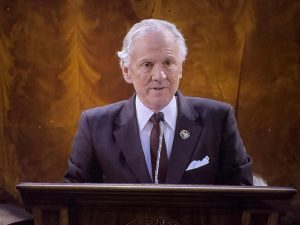 to the General Assembly throughout a period of remarkable advancements. Our partnership shows what we can accomplish when the executive and legislative branches cooperate, collaborate, and stay focused on serving South Carolinians.
As Gov. McMaster finishes up nearly a decade in office, South Carolina today is stronger, more prosperous, and better positioned for the future than when he started. He has helped lead our state forward — and his legacy will be both substantial and consequential.
Reflecting on Success
 Typically, my focus is on the windshield, believing that if you’re not looking forward, you risk going backward. But as I wrap up my 16 years of legislative service, here’s what I see in my rearview mirror.
No single method accurately measures legislative success because what matters to one person may not matter to another. However, from my rearview mirror, these major policy reforms and enacted laws have lasting impact and historical importance, affecting the daily lives and well-being of many South Carolinians.
Comprehensive Income-Tax Relief (2022-2026): We passed the largest income-tax reduction in state history, lowering the top individual rate over several years and providing relief to taxpayers in every bracket. We accelerated rate reductions, locking in a path to a 1.9% income tax rate or eliminating the state income tax.
Property Tax Relief (2026): The property tax homestead exemption for those South Carolinians 65+ increased 50% from $50k to $75k.
Landmark Road-Funding Reform (2017 & 2026): Established a reliable, long-term funding stream to repair deteriorating roads and bridges, and in 2026 we reorganized SCDOT for greater efficiency and accountability.
Pro-Life Act (2023): The Fetal Heartbeat and Protection from Abortion Act protects life beginning with the first heartbeat—generally about six weeks into pregnancy. It bans abortions after a heartbeat is detected except in cases of rape, incest, life of the mother, and fatal fetal anomalies. It does not criminalize the pregnant woman.
Pushing Back on the Federal Government (2022): I’m a federalist and led the legislative efforts for South Carolina to formally call for a Convention of the States to propose constitutional amendments imposing fiscal restraints on Washington, limiting federal power and jurisdiction, and establishing term limits for federal officials. South Carolina is the 19th state to join the national effort. Separately, other bills signed into law call for federal Article V Conventions to balance the federal budget and to consider term limits for Congress and federal judges.
South Carolina Religious Freedom Act (2022): Enacted in response to restrictions imposed during the COVID-19 pandemic, the law designates religious services as essential during a declared state of emergency, banning state and local governments from restricting churches more severely than businesses providing essential services.
Expanded School Choice (2023-2026): Established the Education Scholarship Trust Fund, which provides eligible elementary and secondary students with scholarships to help cover education expenses at the school of their choice. This is a critical step toward creating a more equitable education system and empowering parents.
K–12 education-funding reform (2022): Replaced an outdated 1977 school-funding formula with a student-centered model, consolidated funding streams, and directed more money toward classroom instruction and student needs.
Historic Increases in Teacher Pay (2018–2026): Raised starting teacher salaries from roughly $30,000 to more than $50,000, and increased salaries across the pay schedules to retain experienced educators.
DHEC Restructuring (2023): Dismantled the unwieldy Department of Health and Environmental Control to provide efficiency and better service. Former DHEC responsibilities now shared between a new Department of Public Health and Department of Environmental Services.
Utility Reform following V.C. Summer Collapse (2019): Reformed the Public Service Commission and utility-regulation process, strengthened consumer representation, and required more rigorous scrutiny of utility rates and major energy projects.
Santee Cooper Reform (2021): Increased oversight, transparency, and accountability at the state-owned utility, imposed new controls on debt and major projects, and subjected more of its operations to independent regulatory review.
State Retirement-System Reform (2011 & 2017): Addressed billions of dollars in unfunded pension liabilities by changing contribution rates, funding requirements, and governance to protect retirees and taxpayers.
Banning ESG from Pensions (2023): My legislation ensured the state’s pension system invests its funds solely to maximize returns, with no regard for WOKE Environmental, Social, and Governance goals.
Creating Healthcare Options (2023): We repealed Certificate of Need requirements that were a major hurdle for healthcare providers to build new facilities or expand services where they were desperately needed. This allows more healthcare options with lower costs for patients.
AND THERE’S MORE…
Government Restructuring (2014): Abolished the Budget and Control Board and transferred executive responsibilities to the governor by creating the State Fiscal Accountability Authority to improve state government efficiency.
Ethics & Campaign-Finance Reform (2016): Expanded income-disclosure requirements, strengthened oversight and enforcement, and increased transparency for public officials and political candidates so they operate more openly.
South Carolina Hands-Free and Distracted Driving Act (2025): This law is my personal favorite! This law prohibits motorists from holding or manually using mobile devices while driving, and has proved to have given law enforcement a stronger tool to combat distracted-driving deaths and injuries. Early results show our roads are getting safer, with highway deaths and injuries declining
Domestic-Violence Reform (2015): Reorganized domestic-violence offenses by severity, strengthened penalties, expanded firearms restrictions for offenders, and improved protections for survivors of this criminal conduct.
Human-Trafficking Legislation (2012 and subsequent years): Established human trafficking as a distinct crime, strengthened penalties against traffickers, provided protections for victims, and created our statewide Human Trafficking Task Force.
Penalizing Fentanyl Trafficking (2023): Created a felony criminal offense and increased penalties for fentanyl trafficking.
Law-Enforcement Body-Camera Legislation (2015): Required state and local law-enforcement agencies to develop body-camera policies and provided a framework for funding, retaining, and allowing public access to see these videos. A picture is really worth a thousand words!
Police-Certification & Accountability Reform (2021): Established statewide standards addressing excessive force, chokeholds, the duty to intervene when excessive force occurs, and revoking certification for serious law enforcement officer misconduct.
Bipartisan Election Reform and Early Voting (2022): Created two weeks of in-person early voting, tightened absentee-ballot rules, and strengthened election-security procedures.
Military Retirement-Income Tax Exemption (2022): Eliminated South Carolina income taxes on military retirement pay and made our state more attractive to veterans, retirees, and military families.
South Carolina Disaster Relief and Resilience Act (2020): Created a coordinated statewide approach to disaster mitigation, flood prevention, and resilience, including dedicated offices and funding mechanisms for future emergencies.
Government Information Transparency Enhancements (2017): For seven years, I championed legislation to strengthen public access to government records by establishing firm deadlines for agencies and local governments to respond to and fulfill Freedom of Information requests, limiting excessive fees and deposits, and requiring electronic records to be provided without copying charges. Our bipartisan law also created stronger civil remedies when public bodies improperly withhold or delay records.
These examples represent only some of our many legislative accomplishments. Together, they show how collaboration among lawmakers during my 16 years in the House of Representatives helped make South Carolina a leading destination for the 21st century.
STILL At Your Service
It has been the honor of a lifetime to serve the citizens of House District 86. Although I am retiring from the General Assembly, I remain on duty through the November election and am always available to assist constituents. If I can help, please contact me.
Photos of the Week
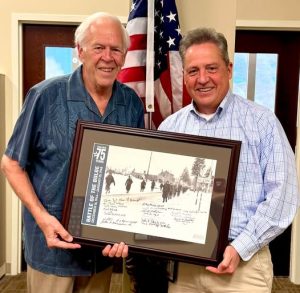 A treasured piece of World War II history has found a meaningful new home. The Battle of the Bulge poster that hung in my State House office is now displayed in the Veterans Affairs Office at the Aiken County Government Center.
During the battle’s 75th anniversary, I asked 14 South Carolina veterans who fought there to sign the poster.
For Aiken County Veterans Affairs Officer Dwight Bradham Jr., it holds a personal connection. His great-uncle Perry was among the American soldiers killed in the Malmedy Massacre during the Battle of the Bulge.
I can think of no better place to honor their service and remember their sacrifice.
