
Budget: Good News, Bad News
Dear Friends:
Good News – South Carolina finally has a state budget. The Bad News – the General Assembly was six weeks overdue in fully funding state government. Since July 1, the state has operated under a stopgap plan that kept spending at the same levels as last year. Unlike Washington, we don’t shutdown government if there is no budget agreement. We passed legislation months ago allowing government to continue to operate until a budget is passed.
What Happened
Reaching compromise between the House and Senate version of the budget happens every year. Usually, it’s not that difficult.
However, this year Senate negotiators repeatedly postponed meetings, pushing discussions into July and August. Why?
Did one Senator prioritize his personal power over the state’s needs? For the first time in my 16 years of legislative service, I felt as if the political brinkmanship that dominates Washington, D.C., had migrated to our SC State House.
More on that later, but first the GOOD NEWS.
New Budget Meets Needs
The $15 billion spending plan that legislators passed Tuesday meets significant statewide needs. Here’s a topline summary:
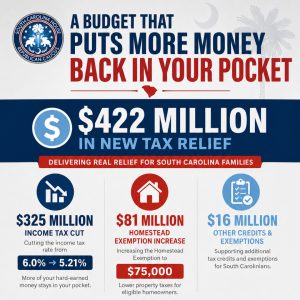 New Tax Relief:
- $422 million in NEW tax relief:
- $325 million cut to state income tax rate from 6% to 5.21% as approved in landmark legislation passed in March.
- $81 million to increase the Homestead Exemption for those 65+. That’s a 50% increase in the exemption from $50k to $75k.
- $16 million in other credits and exemptions.
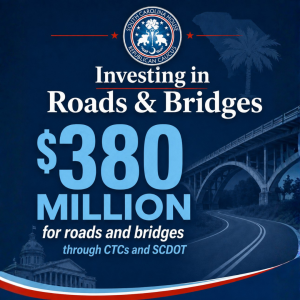 Speeding Up Road Improvements:
- Substantial investment in roads and bridges. $380 million for road and bridge improvements (this is in addition to the gas tax, which is SCDOT’s sole funding source along with federal funds).
 K-12 Education:
- Raises starting teachers’ pay to $50,000 and $2,000 to the teachers’ minimum salary schedule. (7 years ago, the starting salary was a paltry $32,000 and we couldn’t compete in teacher recruiting with other states.)
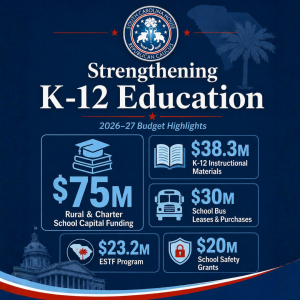
- $75 million for rural and charter school capital funding.
- $38 million for K-12 instructional materials.
- $30 million for new school buses.
- $20 million for school safety grants.
- $23.2 million for ESTF school choice scholarships.
Higher Education:
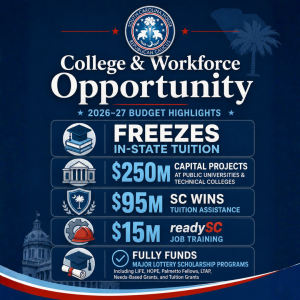
- Making education affordable. Tuition freezes for the 7th consecutive year at SC’s public universities and colleges.
- Full funding for major lottery scholarship programs (LIFE, HOPE, Palmetto Fellows, LTAP, Needs-Based Grants, and Tuition Grants).
- $250 million for capital improvements at public universities and technical colleges.
Job Readiness:
- $95 million for SC WINS for the Technical College System, providing tuition assistance to address workforce shortages.
- $15 million for Ready SC for in-demand job training through the Technical College System.
 Health Services:
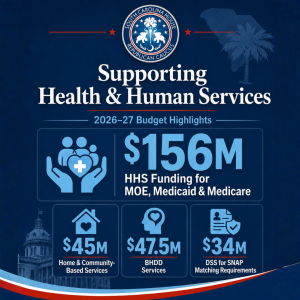
- $156 million to fully fund Medicaid and Medicare.
- $45 million for Health & Human Services Home & Community-Based services.
- $47.5 million for the Bureau of Health and Disability Determination to improve mental health services to the developmentally disabled.
- $34 million to meet new federal standards for SNAP (food assistance) matching requirements.
Public Safety:
- Fully funding state law enforcement salary-step increases.
- $24.5 million to expand Palmetto 800 statewide first responder communications system.
State Employees:
- $67 million for an inflation adjustment of a 2% across-the-board pay increase for state employees.
This budget reflects the priorities we hear about from South Carolinians every day: keeping taxes low, supporting our schools, improving our roads, backing law enforcement and making smart investments in our growing state.
Just as importantly, we did it while maintaining a balanced budget and being responsible with taxpayer dollars.
There is always more work to do, but this budget moves South Carolina forward on some of the issues that matter most to families and communities across our state.
The spending plan is now on Governor McMaster’s desk, where he will consider using his line-item veto.
The Bad News
Passage of the state budget came six weeks late because senators chose to fight over earmarks. There is plenty of finger-pointing at the State House, and the blame game has begun to resemble a merry-go-round at the fairgrounds.
Investing in Our Towns and Cities
Legislative earmarks are critical to South Carolina towns and counties facing serious infrastructure challenges. They support stormwater systems, water treatment plants, roads, bridges, homelessness initiatives, law enforcement, fire departments, and other pressing local needs.
Without this assistance, many communities simply cannot afford the projects necessary to protect residents, maintain essential services, and prepare for future growth.
From “Pork” to Purpose
Historically, earmarks have been criticized as “pork” — funding directed toward legislators’ favored projects rather than clearly demonstrated community needs. The House reformed its process in recent years.
House members must now identify each proposed community investment and provide written justification. Projects that fail to meet established standards can be removed or vetoed by the governor. This year, all nonprofit funding was eliminated, keeping the focus exclusively on essential public projects. Full transparency.
The Senate does not follow the same transparent process. Its requests often include little supporting information. This year, one Senate earmark was submitted on a Post-it note with instructions to include the funding in the budget. No transparency.
One Senator’s Rule
 At the center of this dispute is Sen. Harvey Peeler, chairman of the Senate Finance Committee. During this year’s budget negotiations, he demanded substantial cuts to House earmarks while refusing to make any reductions to Senate earmarks. That double standard raised serious questions about fairness.
Sen. Peeler has served in the Senate for 46 years. Just two years ago, he secured more than $300 million to establish Clemson University’s College of Veterinary Medicine — the largest legislative earmark in South Carolina history. Clemson is his alma mater, and the veterinary college now bears his name.
Last year, he forced the elimination of all earmarks, halting vital projects in communities across the state.
Now he has done it again. For the second consecutive year, South Carolina’s towns and counties will receive no funding for these community investments.
He got his pet project — and then turned off the spigot for everyone else.
The Doomsday Outcome
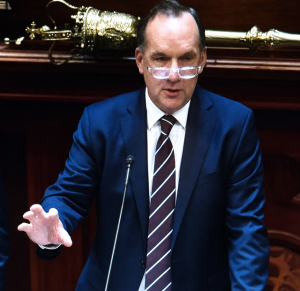 On Tuesday, House Ways & Means Chairman Bruce Bannister explained on the House floor that Senate negotiators never engaged in a genuine, merit-based discussion. According to Chairman Bannister, there was no substantive, project-by-project review of the House earmarks. Instead, Senate negotiators relied on political leverage.
He said senators seemed to be upset that House members had secured more earmark funding, and they demanded an arbitrary reduction that would have cut House projects by nearly 50 percent.
Representatives ultimately reduced the larger earmarks by 40 percent. Even that was not enough for Sen. Peeler and his allies. Negotiations continued until the House voted to pass the budget. The Senate could have voted Tuesday on the reduced earmark proposal, but Sen. Peeler never brought it before the chamber.
Chairman Bannister said: “I think this body ought to push back on one senator who claims he has the decision-making authority for the entire state — and that no constituent can have anything done for them without his approval.”
I wholeheartedly agree.
In a representative government, the will of the legislative body should prevail — not the will of one senator.
Throughout my time in office, I have proudly told people that our State House is different from Capitol Hill in Washington. We work together, find common ground, enact sound policy, and pass balanced budgets.
That tradition has been severely damaged by one senator’s insistence that he alone is in charge. Regrettably, the people of South Carolina will pay the price as their communities go without needed funding.
That is the real bad news.
Photos of the Week
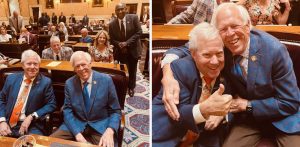
This week’s special session of the General Assembly was likely my final day of floor debate unless we return to consider the Governor’s budget vetoes. I celebrated the milestone with the Aiken Representatives, and especially my longtime desk mate, Rep. Bill Hixon.