
The Infrastructure Powering the Next Generation of Innovation
Dear Friends:
Welcome to the Innovation Age! It’s scary and exciting. Technology is advancing so rapidly it’s difficult to grasp the implications.
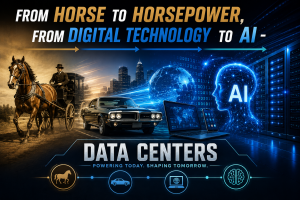 Artificial intelligence (AI) and the data centers that support it are garnering the same sort of resistance the “horseless carriage” received when it first appeared on American roads in the late 19th century. The reaction from a society built around horses and buggies ranged from deep skepticism to outright hostility. The public outrage viewed motorists as a public menace, and laws were proposed to curtail drivers, such as requiring a driver to dismantle the car and hide the parts if a horse refused to pass.
Despite the early friction, curiosity took hold as people saw the advantages of motorized transportation and how cars, tractors, and trucks would revolutionize personal travel, farming, and manufacturing.
The transition from horse to horsepower wasn’t an overnight triumph. It was a messy, loud adjustment period until automobiles proved their worth.
Fast Forward to Today
History and human nature are often repetitive. The 1890s sound familiar to the blowback AI and data centers are getting today. In an era defined by rapid technological advancement, those two connected entities have become an easy target. Yet, their contributions are fundamental to America’s safety and the evolution of society.
Then & Now
South Carolina has long built its economy by adapting to new industries. In the late 1800s, the state harnessed its water and energy resources to transform raw cotton into manufactured goods, with Aiken County emerging as a major textile center. When the textile industry declined, South Carolina successfully reinvented itself as a leader in advanced automotive manufacturing.
Today, data centers represent the next chapter in that evolution, converting raw data into computing power that fuels artificial intelligence, healthcare, business, education, and national defense. Far more than warehouses for information, data centers are the critical infrastructure powering the digital economy and the innovations that will shape our future.
The Race for AI Superiority
Look no further than un-social media to spread lies about the evils of data centers. It has been confirmed that our national adversaries are helping drive Americans’ negativity. After all, our enemies want us to fail so they win. It is estimated that China has as many as 700 commercial and hyperscale data centers, and 2,000 large-scale data centers. Data centers of every size exceed 70,000 in China. Clearly, America is in an arms race with its adversaries because AI supremacy is essential for national defense and economic stability.
*** Myth Busting ***
MYTH: Data centers consume enormous amounts of electricity and drive up everyone’s utility bills.
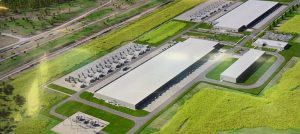
REALITY: Virginia, the nation’s data center leader with more than 600 facilities, has experienced rapid data center growth without electricity prices rising faster than inflation. Data centers pay to expand the grid and absorb significant fixed utility costs; they can actually help stabilize rates because they require a constant load that utilities can count on versus the up-and-down requirements of the rest of the grid. In Aiken County, Meta funded its own transmission lines, two substations, and a $100 million solar project that adds power back to the grid.
Looking ahead, small modular reactor (SMR) technology, not the local electrical grid, will be powering data centers. That is a similar generation source that has been powering our nuclear submarine fleet around the world for generations.
Additional consumer protections came last week when South Carolina Governor Henry McMaster joined 22 other Republican governors who signed President Trump’s expanded Ratepayer Protection Pledge that calls on AI data center developers to pay for the costs of new electric generation and grid upgrades needed to serve their facilities. This ensures that costs are not shifted to residential or small-business utility customers through higher electric rates.
 MYTH: Data centers will drain local water supplies.
REALITY: Modern facilities use highly efficient, closed-loop cooling systems that recycle water for years. Meta’s Aiken County data center uses about the same daily water as a mid-sized office building (i.e., flushing toilets, etc.). Nationwide, data centers account for less than 0.4% of U.S. water consumption. Nationally, golf courses consume 15 to 30 times more water than data centers.
MYTH: Data centers exist only to benefit Big Tech.
REALITY: Data centers power the digital services we all rely on every day — from hospitals and banks to schools, emergency responders, cloud storage, and the millions of smartphones in our pockets. Every online search, financial transaction, telehealth visit, and AI application depends on data centers.
MYTH: Data centers provide little value to local communities.
REALITY: Nationally, they bring in billions in private investment, generate substantial property tax revenue, create thousands of construction jobs, and support hundreds of high-paying permanent positions. The result is a stronger local economy and a broader tax base that benefits everyone.
One Example: Transforming Healthcare
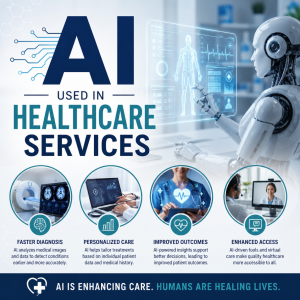 mproving your health is just one example of how AI and data centers are revolutionizing our lives. They support artificial intelligence and predictive analytics, helping healthcare providers identify potential illnesses earlier and tailor preventive care to individual patients. These capabilities are advancing the shift toward more personalized and proactive medicine. Data centers are driving breakthroughs in genomic medicine by processing vast amounts of genetic data and enabling collaboration among scientists worldwide. Together, these technologies are improving patient outcomes, expanding access to care, and accelerating the development of more precise, effective treatments.
Embracing the AI Innovation Era
As America stands at the dawn of the AI era, we face a choice. We can embrace the infrastructure that will power the next generation of innovation, or we can allow fear, misinformation, and shortsighted political policies to slow our progress.
History teaches that every transformative technology has faced resistance. Railroads, electricity, automobiles, and the internet all encountered skeptics who focused on perceived risks rather than extraordinary opportunities. Yet each ultimately made America stronger, more prosperous, and more competitive.
Data centers today’s essential infrastructure. They power the digital economy, support hospitals, schools, businesses, first  responders, and national defense, while providing the computing capacity that will drive breakthroughs in medicine, manufacturing, agriculture, and scientific research.
Unlike New York State, which foolishly placed a moratorium on data center construction, South Carolina welcomes responsible development that will attract billions in private investment, strengthen our tax base, and position South Carolina at the forefront of the AI revolution.
The question isn’t whether we will have data centers — thousands will be built in the coming years. The question is where. Local governments are responsible for zoning that will place data centers in business and industrial parks, or spaces that won’t be in your backyard, thus addressing the NIMBY backlash.
Just last week, the National Nuclear Security Administration announced the development of an AI data center and dedicated on-site energy generation source at the Savannah River Site right here in Aiken County. It will be one of the nation’s largest integrated AI and energy infrastructure projects. This project supports the Trump administration’s goals of utilizing Federal lands to lower energy costs and help power the global AI race.
America has never led the world by fearing the future. We have led by building it. The same vision that once connected our nation with railroads, highways, and electric power should now inspire us to invest confidently in the digital infrastructure that will define the next century. Data centers aren’t just buildings — they are the foundation of America’s technological future.
(Note: This data center analysis was published in today’s Aiken Standard newspaper.)
Newsworthy Notes
South Carolina’s Pro-Growth Blueprint: Jonathan Williams on The Hugh Hewitt Nation Radio Show
 “I’m very bullish on the future of South Carolina, especially if they keep down this trajectory.” — Jonathan Williams
National conservative talk show host Hugh Hewitt spoke with ALEC President and Chief Economist Jonathan Williams about South Carolina’s increasingly strong economic trajectory and its role as a model for becoming a low-tax, pro-growth state.
Williams praised South Carolina for recent legislative changes that strengthen the state’s economic outlook and attract more residents.
“It just happened that Governor McMaster signed into law their massive red tape reduction and deregulation bill that our great friends there, Speaker Smith and others, have been working on. It includes REINS Act-style reform, Chevron deference, and, of course, add that to the tax cuts.”
He further praised the state’s efforts, noting its commitment to pro-growth tax policies, which in turn attracted residents in numbers that even surpassed Florida’s in-migration numbers last year.
As South Carolina moves “toward a 1.99% flat tax, as well as a total elimination of the personal income tax,” Williams concluded, “I’m very bullish on the future of South Carolina, especially if they keep on this trajectory.”
Fast Campaign for the Senate
In Aiken County’s horse country, they might say, “Dang, we’ve got a herd of folks that want to be in the Senate.” A total of 10 candidates filed to run for the Republican nomination in the August 11 Primary. Yup, there is most definitely a herd of Republicans who want to fill the Senate seat of the Late Lindsay Graham.
Some of those running aren’t qualified, in my view. Some are perennial candidates who want another moment in the limelight. Still others are aging out.
For me, there is one candidate who represents the next generation of Conservative Republicans.
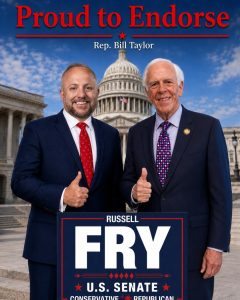
This week, more than 40 state legislators joined in endorsing Russell Fry for the U.S. Senate because we know his solid character and motivation to serve people.
Like my colleagues, I served with Russell in the State House. In 2022, we teamed up to win passage of the Article V Convention of States Resolution, allowing states their rightful duty to rein in the bloated federal government.
I know firsthand that Russell is just what South Carolina needs in Washington, representing our Conservative values. As a two-term Congressman, he has worked hard to represent SC and the 7th Congressional District.
In Russell’s words, “South Carolina families deserve better than a bloated, dysfunctional Washington that’s driving up the cost of living. I’ll fight every day in the US Senate to advance the American First agenda and help working families get ahead – not just get by.”
Russell Fry would be honored to earn your vote on August 11th.
The Birthday I Won’t Forget!
I suppose a milestone birthday is cause for celebration. Well, my 80th birthday was a humdinger!
Family, friends, and legislative colleagues joined the party at Aiken’s Green Boundary Club. No gifts, just roasts and toasts, and a lot of fun.
Members of the Aiken Legislative Delegation joined others in telling stories about me but then came the surprise moment. It was announced that Governor Henry McMaster honored me with The Order of the Palmetto, as shown in the Aiken Standard.
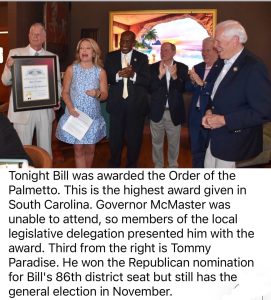
I am humbled by the recognition. These past 16 years serving in the House of Representatives have been a blessing. I thank the Lord for giving me good health and the vigor to serve, and the unwavering support from my wife, Donna, and family, and the voters of House District 86 for trusting me to represent them. I am blessed beyond measure.
Photo of the Week
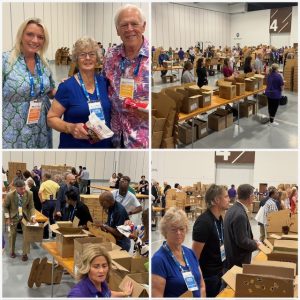
Donna and I were happy to join legislators from around the South to pack 100,000 care boxes of food for those in need. We attended the Southern Legislative Conference in Lexington, Kentucky, where we partnered with God’s Food Bank on their Campaign Against Hunger for those in need in central KY.