
Dear Friends:
This week in Columbia, there was meaningful progress on legislation focused on public safety, strengthening civics education in our schools, and putting South Carolina families first!
Displaying the 10 Commandments
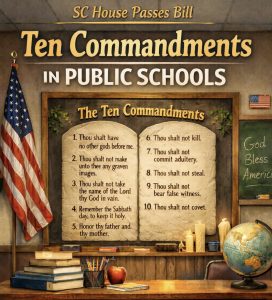 One highlight of this week was the SC House’s approval of legislation requiring all public-school classrooms, including those at state colleges, to display the Ten Commandments along with a context statement explaining their historical significance in public education.
Remember, America was born in the pulpit.
This legislation ensures schools display foundational historical documents — including the Ten Commandments — as part of an educational presentation highlighting the documents that have shaped American law and government. This bill reflects those values, reinforcing civic education, respecting our heritage, and supporting the next generation.
The vote was 84-31, largely along party lines, with one Democrat voting in favor and one Republican opposed. It mandates an 11-by-13-inch poster or framed copy of the Ten Commandments in every classroom statewide. The legislation also allows schools to accept volunteer chaplains, with parental consent required before students participate in any related activities.
As one of the many sponsors of the bill, I believe it reinforces the moral foundations of the nation and highlights the historical role the Ten Commandments played in shaping American law and government.
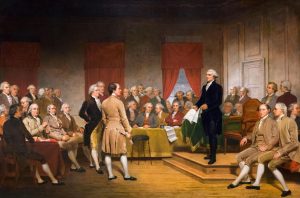 The Bible was the most-cited source among our nation’s Founders. A team of scholars confirmed this through their analysis of more than 3,000 quotes by the Founders: 34% referenced Scripture directly, and indirect biblical influences raised that figure to above 60%.
John Adams stated plainly that the general principles underlying independence “were the general principles of Christianity.”
A hundred years ago, historian Alice Baldwin documented that every central idea found in the Declaration of Independence had first been preached in colonial pulpits before 1763.
America was, quite literally, born in the pulpits.
If enacted into law, the display would serve as a daily reminder of the country’s origins and provide students with exposure to principles that influenced the development of legal and civic institutions.
The vote comes days after a federal appeals court allowed a similar Louisiana law to remain in effect while constitutional challenges move forward.
Senate Sweetens House Income Tax Reform Plan
 SC taxpayers are likely to see a revamped state income tax structure that lowers taxes for a large share of filers after the Senate approved changes to a House tax reform plan this week.
The amended bill, which passed the Senate 39-5, would reduce state income tax rates and provide tax relief to more filers in its first year. Under projections, 43% of taxpayers would pay less in the calendar year covered by filings due in spring 2027. About 35% would see no change, while 23% would pay more, most of whom would pay $50-250.
The Senate’s version is more costly to state coffers. It reduces income tax revenue by more than $308 million in its first year, compared with $119.1 million under the House plan. The bill now returns to the House, where Representatives will decide whether to accept the changes or negotiate a compromise. Any final tax cut will be folded into broader state budget negotiations.
Senate leaders ensured the plan reflected their aggressive approach to tax cuts, including Budget Chairman Harvey Peeler, known for quipping, “You cannot out-tax cut Harvey Peeler.”
Combined with a separate bill expanding property tax exemptions for seniors’ primary residences, the Senate’s tax package could reduce available state spending by roughly $556 million next fiscal year.
The legislation also continues the state’s effort to decouple its income tax system from federal taxable income, a structure used by only a handful of states. This move allows for clearer comparisons with neighboring states and prevents SC’s tax policy from being driven by federal changes.
The bill sets a long-term goal of eliminating the state income tax entirely, requiring annual $200 million reductions whenever collections grow by at least 5%.
WARNING: EYES UP, PHONE DOWN
 Today, February 28th, SC’s Hands-Free Driving Law goes fully into effect.
No more warning tickets. The 180-day “warning window” ended at midnight Friday.
If you are caught holding your phone or any other electronic device while driving, the first violation carries a $100 fine. Every subsequent violation will cost $200 and add two points to your driver’s license — points that will likely translate into costly increases in your vehicle insurance. Avoiding that insurance hit alone should be reason enough to hang up.
I worked for eight years to pass this law, encountering more than a few legislative speed bumps along the way. Finally, it became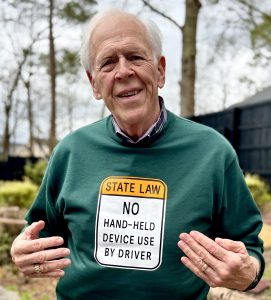 law late last year. At the State House ceremony where Gov. Henry McMaster signed the bill, I said, “Someday, distracted driving will be viewed as just as reckless, dangerous, and unacceptable as driving drunk. Stop doing it.”
A common question I hear is whether the law will really be enforced.
Last weekend, while fueling my car, I pulled up next to a state trooper filling his unmarked black patrol vehicle — the kind you don’t recognize until it’s too late. I asked him about enforcement. He didn’t hesitate: “We’re eager,” he said. “Really eager to start writing tickets.”
Here in Aiken County, law enforcement will ticket drivers caught holding their phones. The Aiken County Sheriff’s Department informed deputies with written instructions that included this: “This is another tool for your toolboxes to help the motoring public with safe driving in our county and our State.”
Some drivers are skeptical that law enforcement can spot them using a phone. The trooper I spoke with laughed. “It’s easy to see.”
During the six-month warning period, more than 12,000 tickets were issued.
Here is another example – consider our seat belt law. South Carolina has a 90% compliance rate, leaving roughly 10% of drivers unbuckled. If you think a seat belt strap is hard to notice, think again. Last year alone, officers wrote 65,000 seat belt tickets statewide.
Like most responsible drivers, law enforcement is tired of the erratic driving caused by people who prioritize their phones over the road. According to the South Carolina Department of Public Safety, distracted driving contributes to more than 20,000 crashes each year.
You can still use your phone. The law allows hands-free use through Bluetooth or an earpiece. But holding it while driving will earn you a ticket — and possibly have far worse consequences if a crash occurs. (Want to know more? DPS’ Hands-Free Brochure)
LEGISLATIVE BRIEFS
Urgent Extension of Alcohol Training
Thousands of SC hospitality workers have not yet completed the state-required alcohol server training under last year’s liquor liability law. It’s estimated that only about 20% are certified. As a result, House and Senate leaders agreed to extend the compliance deadline from March 2 to May 1 to give workers more time to complete the several-hour course. The House quickly passed a joint resolution to formalize the extension, with final legislative approval and the governor’s signature expected soon. Insurers have not lowered liquor liability premiums because most eligible workers remain uncertified.
South Carolina Jobs First
The Buy American Iron & Steel Act (H.4709) passed the House unanimously this week. This important legislation ensures taxpayer dollars prioritize American-made iron and steel in state-funded projects, strengthening domestic manufacturing and supporting South Carolina jobs. We are putting America First — right here in South Carolina!
Workforce Readiness
We also advanced the Workforce Readiness bill (H.3197), focused on better preparing South Carolina students for success after graduation. This legislation strengthens pathways to industry credentials and postsecondary education while aligning high school outcomes with real workforce needs. By raising standards and expanding opportunity, we are building a stronger workforce and a stronger future for our state.
Being Truthful
The Truth in Public School Grading bill (H.5073) was reported out of the Education & Public Works Committee. Parents deserve transparency and honesty regarding their child’s academic progress. This legislation ensures grading policies reflect real achievement and provide families with clear, accurate information, because high standards and honest feedback are essential to preparing students for success in college, careers, and life.
Supporting Public Safety
The HALO Act (H.4763) advanced out of the full Judiciary Committee and will be on the House calendar. HALO stands for Helping Alleviate Lawful Obstruction. This bill sends a clear message that SC backs the brave men and women who serve on the front lines of law and order. By establishing a 25-foot safety radius, this bill ensures law enforcement officers and first responders have the space they need to act quickly, decisively, and safely in high-pressure moments.
It also strengthens penalties for those who harass, obstruct, or assault them while they are simply trying to do their job. When lives are on the line, interference isn’t just disruptive; it’s dangerous. SC won’t tolerate the disruptions, mostly by paid protestors, which are wreaking havoc in the big, blue cities. Protesting is okay; anarchy is not.
Immigration Enforcement
In addition, the Immigration Enforcement bill (H.4764) passed out of a Judiciary Subcommittee. This legislation strengthens cooperation between state and local law enforcement and federal authorities to ensure individuals who are in our country unlawfully and commit crimes are properly identified and processed. A growing number of law enforcement agencies across our state are already implementing these partnerships and taking proactive steps to uphold the rule of law — and that’s exactly why we are working to pass this legislation statewide: to support their efforts and ensure every community has the tools it needs to keep families safe. Protecting our communities remains a core responsibility, and public safety will always come first.
Juvenile Crime Reform
Advancing out of the House Judiciary Committee is a comprehensive Juvenile Crime Reform Package (H.4151, H.5120, H.5121) to crack down on serious youth violence and restore order in our communities. These bills ensure violent juvenile offenders face real consequences, strengthen coordination between schools and law enforcement when major crimes occur, and invest in prevention efforts that reinforce discipline and accountability. This is a firm but fair approach: public safety comes first, and serious crimes will carry profound consequences, regardless of the offender’s age.
Penalties for Child Sex Abuse Crimes
The Senate unanimously approved legislation strengthening penalties for child sexual abuse material offenses. The bill increases minimum prison sentences, particularly for registered sex offenders and repeat offenders. Those convicted of trafficking or coercing a child into producing images would face at least 10 years. The measure also establishes tiered minimum sentences for possession based on the number of images. Current law sets no minimum. The bill now heads to the House for consideration.
‘Shrimpgate’ Remedy
A House panel has advanced a bill that would require all shrimp sold in SC to be clearly labeled with their country of origin, following reports of widespread mislabeling at Lowcountry restaurants. Sponsored by Bill Herbkersman, the measure (H.4248) would prohibit restaurants, markets, and sellers from offering shrimp without conspicuous origin labeling. The proposal follows genetic testing commissioned by the Southern Shrimp Alliance, which found that most sampled Charleston-area eateries sold foreign shrimp. Violations could result in misdemeanor charges, jail time, and fines of up to $1,000. The bill mirrors laws adopted in other coastal states to protect consumers and domestic shrimpers.
NIL Bill Sent to the Governor
The Senate cleared the way Thursday for final passage of a fast-tracked NIL bill (H.4902) that shields revenue-sharing contracts between public universities and student-athletes from disclosure. Some Senators were concerned about transparency and university finances. The athletic directors from Clemson, USC, and Coastal Carolina pledged that no taxpayer dollars would be spent on payments to student-athletes. The bill exempts NIL (Name, Image, & Likeness) contracts from public records laws, requiring schools to disclose only total payouts. Gov. McMaster has repeatedly raised transparency concerns and has not said whether he will sign or veto the measure. Five other states — Louisiana, Kentucky, Utah, Arkansas, and Colorado — have passed similar legislation.
Banning Chemtrails
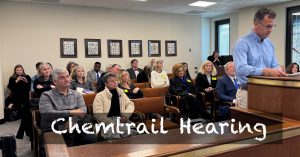 A House subcommittee took testimony this week on a bill to ban chemtrails over SC’s airspace. The proposed legislation (H.3915) would make it a felony to intentionally release or disperse chemicals, substances, or energy-based technologies into the atmosphere to alter temperature, weather patterns, storm intensity, or sunlight levels. The bill, mostly sponsored by members of the House Freedom Caucus, targets large-scale geoengineering activities — including aerosol injections or other methods intended to manipulate weather or dim sunlight. Violators could spend 10 years in prison and face a minimum fine of $500,000 per day. The subcommittee ran out of time and took no action.
Jesse Jackson Honored
South Carolina native and civil rights icon Jesse Jackson will lie in state Monday, March 2, at the South Carolina Statehouse. It is a rare honor. A 9 a.m. procession will depart Leevy’s Funeral Home, with public viewing at the State House from 11 a.m. to 4:30 p.m. A memorial service will follow at Brookland Baptist Church from 4-6 p.m. Jackson died Feb. 17 at the age of 84.
Aiken County Noteworthy
A new acronym to know: RSOC — the Regional Security Operations Center. And it’s a big deal.
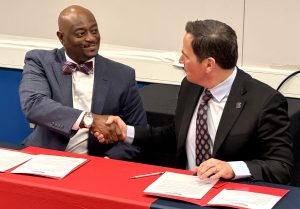 This week, USC-Aiken and the Aiken County Public School District signed an agreement that expands cybersecurity protection right here at home. USC-Aiken’s student-run RSOC will now provide real-time cyber monitoring, threat alerts, incident response, and system audits for the school district, helping protect more than 23,000 students and 3,500 employees from cyberattacks.
The stakes couldn’t be higher. Weak cybersecurity can expose student records, disrupt payroll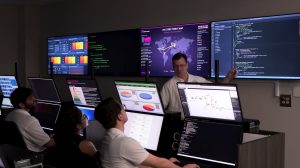 and grading systems, and interfere with child-protective and safety operations. The RSOC helps stop those threats before they cause damage — monitoring networks and shutting down bad actors in real time.
Just as important, this partnership builds a cybersecurity pipeline connecting K-12 schools, the university, and regional employers. University students gain firsthand, workforce-ready experience, and upon graduation, move directly into high-paying, critically needed cybersecurity careers.
This is smart security, smart education, and smart economic development—all in one.
Aiken Tech Super Stars
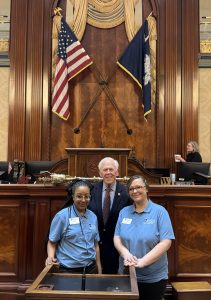 Aiken Tech brought two Super Star students to the State House this week as part of the annual visit by all of SC’s Tech Colleges. Alice Brown, Student Government President, (Photo Right) has been selected as the commencement speaker for the May graduation. Alicia Green is the VP of the SGA (Photo Left), and earlier this week, she received news that she has been awarded the Coca-Cola Scholar award for South Carolina. She will receive a scholarship in Baltimore in March.
PHOTO OF THE WEEK
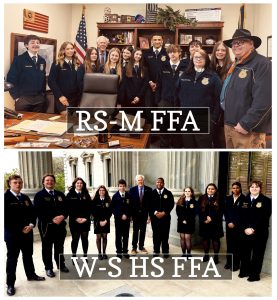
Wednesday was the annual FFA DAY at the State House. It was an honor to hang out with the FFA students from Wagener HS & Ridge Spring-Monetta HS. Do you like to eat? The grocer sells you food. Thank a farmer and the Future Farmers of America for planting, harvesting, and sending food to your grocery store.