
Dear Friends:
Typically, the first few weeks of each legislative year are slow, as committee meetings focus on advancing bills to the floor for debate. This year, we seem to be moving at “Trump Speed!”
Abortion Restrictions Strengthened
It was a 5-hour debate on Wednesday that concluded with the SC House approving legislation aimed at tightening the state’s ban on mailing abortion-inducing drugs that are flooding our state.
The bill (H.4760), which passed 81-31, strengthens the existing law that already prohibits mailing abortion pills and requires in-person prescribing. Supporters say it closes loopholes that allow patients to obtain the drugs through out-of-state telehealth providers.
Two amendments were added. One makes it illegal to raise or distribute money to help purchase the pills, allowing authorities to seize those funds. Another creates a potential life sentence for anyone who secretly gives the drugs to a pregnant woman to end a pregnancy without her knowledge.
The legislation classifies Mifepristone and Misoprostol as Schedule IV drugs, requiring a prescription from a SC doctor. Possession without a prescription could result in up to five years in prison and a $5,000 fine. However, the bill prohibits the prosecution of pregnant women for personal use. Families would also gain the right to sue out-of-state providers who knowingly supply the drugs to SC residents.
Some members of the hardline Freedom Caucus argued the bill does not go far enough and unsuccessfully pushed for a total abortion ban. Others, like me, supported the measure as a practical step to strengthen enforcement.
Supporters countered that the drugs would remain available for legal abortions and medical emergencies, emphasizing that the legislation targets illegal distribution rather than medical care.
Senate Strengthens SC’s DUI Laws
Factoid: South Carolina has one of the nation’s highest drunk driving fatality rates, with nearly half of all fatal crashes in the state involving a drunken driver.
 That could change with the Senate’s unanimous passage this week of an overhaul of state laws against driving under the influence in an effort to reduce deaths on SC’s roads. It has been a top priority this year, moving at lightning speed through the Senate’s typical methodical process, and could bring big changes to SC’s loosely enforced DUI laws.
The bipartisan legislation (S.52) adds penalties when the intoxicated driver injures, rather than kills, someone to the point they lose consciousness or have to undergo anesthesia to be treated. It also toughens penalties, removes obstacles that allow charges to be dismissed on videotaping grounds, and encourages individuals to submit to breathalyzer and blood testing.
Senate Majority Leader Shane Massey may have said it best, telling reporters, “We are making it more uncomfortable even for the first offense. The idea is to include enough of a deterrent effect that people aren’t going to want to do it.”
Historically, more than half of all DUI charges have been plea-bargained down to lesser offenses. Those cases are prosecuted by

police officers in traffic court. That’s not a fair fight going up against defense lawyers who specialize in DUI’s. The Senate bill mandates that prosecutors handle court proceedings for even the lowest-level DUI cases.
Lawmakers cannot mandate breathalyzer or blood testing, but under this bill, those who refuse to submit to such testing face steeper penalties upon conviction. Additionally, those who decline voluntary testing may get a temporary license but will be required to install an ignition interlock device, which prevents a car from starting until the person blows into the machine to prove they’re not intoxicated.
I have seen too many repeat DUI offenders back behind the wheel under our current system. This appears to be a step in the right direction. I urge the House of Representatives to prioritize this bill so that it becomes law this year.
Road Bump for Regulating Hemp-High Drinks
 After hours of spirited debate on Wednesday, Representatives voted to send back to committee legislation aimed at restricting hemp-derived THC products that provide a marijuana-like high, despite marijuana remaining illegal in the state. The legislation (H.4759) is in response to concerns that unregulated THC-infused drinks and edibles are widely available, including to minors, due to loopholes created by the 2018 federal farm bill.
Most legislators agree that minors should be protected. The hemp industry says a ban would devastate small businesses and eliminate products many people use for pain and anxiety relief. Industry advocates favor limited regulation over an outright ban and argue that responsible sellers already enforce age limits. Hopefully, improved legislation will reemerge from the Judiciary Committee.
Supporting Small Businesses & Job Creators
Small businesses are the backbone of South Carolina’s economy, making up more than 99% of all businesses in SC and employing 42% of our state’s workforce. This week, the House Ways and Means Committee approved legislation (H.5006) to cut taxes and reduce burdens on small businesses. This legislation exempts the first $10,000 of small-business assets, saving employers time and money on paperwork, reducing costly red tape, and ending a burdensome tax on investments. It also shifts responsibility for assessing and collecting those business property taxes from county offices to the SC Department of Revenue. The legislation is estimated to reduce local property taxes by $9.1 million annually. It is now on the House floor calendar to be debated. If signed into law, most provisions take effect in 2027.
Tax Filer Confusion Explained
I have been hearing from constituents and CPAs about this year’s confusion regarding tax filing. That’s understandable. South Carolina’s tax laws are in flux (in a good way) because we are working to reduce the tax rate and eventually eliminate SC’s income tax.
Historically, the General Assembly, each year, passes a “tax conformity” bill to decide whether the state will adopt recent changes to the federal tax code. Because the state bases its income tax system on federal law, changes in Washington directly affect how South Carolinians file their state returns.
At the heart of this year’s confusion is the federal “One Big Beautiful Bill,” which created new deductions, expanded credits, and revised business expense rules. While those changes reduced federal tax bills for many filers, they also created uncertainty at the state level for taxpayers and tax preparers who are uncertain which federal provisions apply in South Carolina, and which do not.
Complicating matters is the legislature’s effort to reform our state income tax that would move SC away from relying on the federal tax code altogether.
The House passed an income tax reform package last year that would significantly change how SC calculates tax liability. A key component of the bill is decoupling from the federal tax code and using adjusted gross income as our base, the same as most other states. The bill is moving quickly through the Senate and could go to the Governor within the next few weeks.
Until that issue is resolved, full conformity could undermine long-term state tax reform efforts. As a result, lawmakers are leaning toward a limited conformity bill that focuses solely on technical updates. State revenue officials are developing guidance, but until final decisions are made, many South Carolinians remain uncertain about how to file their state income taxes accurately.
LEGISLATIVE BRIEFS
Other Bills Advancing Through the Legislative Process
In addition to the work highlighted above, several other important pieces of legislation continued moving through the General Assembly this past week.
- A bipartisan bill (405) that passed unanimously strengthens SC’s child abuse homicide statute by increasing the age covered under the crime from under 11 to under 18. This change ensures harsher penalties and greater accountability for those whose abusive or neglectful actions result in the death of an older child — reflecting our shared commitment to protecting all South Carolina children. The amended bill passed is being returned to the Senate.
- The House passed a bill (3551) to help recruit and retain election workers by exempting them from paying state income taxes on the little pay they receive for working elections. The legislation is projected to reduce taxes paid by about $190,000 per year starting in the 2026–27 budget cycle.
- Legislation increasing penalties for the sexual exploitation of minors advanced in a House Judiciary Subcommittee. This bill strengthens criminal penalties to ensure punishment fits the severity of these crimes and makes clear that “mistake of age” is not a defense for creating or distributing exploitative material. SC will not tolerate the exploitation of children.
- The Judiciary Subcommittee also advanced legislation aimed at protecting children online by addressing the growing mental health and safety risks posed by addictive social media platforms. The bill requires reasonable age verification, parental consent, and increased transparency, giving families more control over how and when minors access social media. These commonsense protections help limit screen addiction and safeguard the well-being of South Carolina’s youth.
- Sixty House Republicans have sponsored legislation that protects parental rights (4757), affirming that moms and dads — not the government – are best equipped to make decisions about their children’s upbringing, education, and well-being. The bill is moving forward in committee.
- Legislation strengthening workforce readiness (3197) continues advancing, helping ensure students graduate with the skills needed to succeed in today’s economy and meet the needs of South Carolina employers. This effort supports job growth, economic competitiveness, and a stronger pipeline between education and the workforce.
- The House is advancing legislation to recognize the U.S. Space Force under SC law (4586). This update ensures Space Force members and their families receive the same legal protections and benefits as other service members — including military leave, voting rights, and family-related matters.
- Legislation expanding certificate-of-need exemptions for veterans’ homes (4799) also moved forward. It cuts red tape, making it easier to provide care for the men and women who have served our country. This commonsense reform helps ensure veterans have access to the facilities and services they deserve.
- A House panel advanced a bill requiring SC colleges to provide mandatory campus safety training for new students, following recent violent incidents and hoaxes that traumatized campuses. The effort was prompted by a swatting incident at the University of South Carolina and shootings during South Carolina State University’s homecoming weekend. The bill (4739) requires public and private colleges receiving lottery funds to train students within their first 30 days on evacuation and lockdown procedures, personal safety, emergency alerts, mental health resources, and reporting crimes such as sexual assault and stalking. The legislation also requires schools to share detailed reports with state agencies and students annually. Supporters say the bill will improve safety and reassure families.
- Next week, the Senate will turn its attention to charter schools and their authorizers, which are, by law, either school districts, the state’s public charter system, or colleges and universities. The legislation (S.454) is a Senate priority aimed at addressing transparency and conflicts of interest, including “authorizer shopping,” in the charter school system. The House Education Committee has also identified charters as a top legislative priority.
AI & Cyber Week @ USC-Aiken
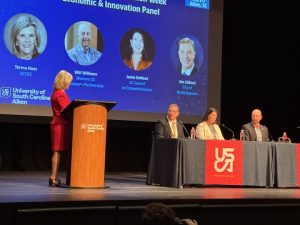 AI & Cyber Week at USC Aiken showcased the university’s growing leadership in artificial intelligence, cybersecurity, defense, energy, and workforce development. The highly focused week brought together national experts and policymakers for meaningful dialogue and collaborative action, highlighting USCA’s expanding role in cybersecurity education and applied research.
I attended Friday’s session on collaboration across the community to foster Aiken’s Innovation Corridor, which marked a major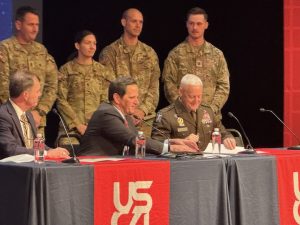 milestone: the signing of a Memorandum of Understanding (MOU) between the South Carolina National Guard and USC Aiken. The Guard’s Adjutant General, Robin Stilwell, and USCA Chancellor Daniel Heimermann formalized a partnership to advance cybersecurity training and cooperation. As part of this initiative, the National Guard is constructing a Cyber Center on campus, along with an armory to house its Cyber Battalion—one of only five such units in the nation.
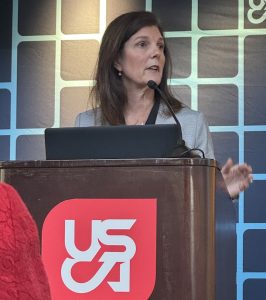 South Carolina Lt. Governor Pam Evette delivered the keynote address at Friday’s luncheon, and I was honored to introduce her. She praised USCA’s leadership in AI and cybersecurity and challenged educators, policymakers, and community leaders to better prepare middle and high school students for the expanding career opportunities in these critical fields.
PHOTO OF THE WEEK
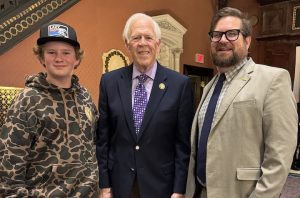 I love meeting with constituents, particularly when they visit the State House. Meet Bentley Wallace, a 7th grader at Wagener’s A.L. Corbett Middle School. He was job shadowing with Adam Jones, who introduced us. Bentley says he’s interested in debate. He came to the right place — he got to witness part of the day-long House debate on banning mail-in abortion pills.
