
Dear Friends:
 As I reflect on my 16 years of service, I realize I’ve witnessed this scenario eight times before: the final stretch of a two-year legislative session. During this critical period, key legislation that has successfully passed through either the House or Senate awaits approval from the opposing chamber.
This recurring standoff often leads to intense bargaining, where the mantra can devolve into a “You pass our bills, and we’ll pass yours” scenario. It’s a classic strategy of leveraging individual needs toward a détente of sorts in order to achieve mutual goals. While such negotiations typically yield results, they are fraught with tension in the last 12 days of the legislative session, as it becomes a make-or-break moment for essential bills. This urgency tends to fuel the political intrigue in these final weeks.
Be assured, legislative leadership is well-intended. Like most legislators, they want good policy signed into law. So, buckle up for an often bumpy month-long State House ride.
 Critically important bills that are significant agenda policies for the House Republican Caucus are pending in the Senate:
- The “Ending Illegal Discrimination and Restoring Merit-Based Opportunity Act” prohibits SC state and local entities, including educational institutions, from promoting diversity, equity, and inclusion initiatives. This bill (3927) aims to enforce merit-based opportunities, uphold civil rights laws, and enhance individual initiative, emphasizing qualifications over identity-based preferences.
- SC’s “Parental Rights Act” strengthens parents’ rights in directing their children’s upbringing, education, and healthcare. 4757 mandates standards for local education agencies, enhances parental consent for medical treatment, and establishes procedures for addressing violations. A significant step toward affirming family authority!
- The “Small Business Regulatory Freedom Act” will reduce regulatory burdens on businesses by at least 25%. The bill (3021) mandates a review of all existing regulations and includes a “shot clock” for new regulations, ensuring expedited assessment and the potential removal of outdated rules, while exempting those needed for federal conformity.
- If this bill, 5006, emerges from the Senate, SC’s small business owners would see a reduction in property taxes on office furniture, machinery, and appliances. These companies are the backbone of SC’s economy and the lifeblood of local communities. They represent 99% of businesses in SC.
- Legislation to enhance the state’s workforce development initiatives is pending in the Senate. 3477 aims to improve job training programs, increase collaboration between educational institutions and employers, and promote career pathways. The bill is designed to address workforce shortages and better prepare individuals for available job opportunities in various sectors.
- Immigration enforcement in SC advances with the Senate passage of 4764, which mandates that all law enforcement agencies operating jails or correctional facilities enter into formal agreements with federal immigration enforcement agencies to participate in federal programs that authorize state or local officers to enforce federal immigration laws.
- The House bill (4755) changes how judges are selected in SC by giving the Governor more power, preventing some politicians and their relatives from serving on the selection board, and removing diversity criteria from consideration.
- This legislation (4151), pending in the Senate, allows for serious youth offenders aged 16 or 17 to be treated more like adults when they commit violent crimes. This change aims to enhance public safety by holding repeat offenders accountable while still allowing the court discretion to determine appropriate actions.
Let’s move these priority bills.
Historic Reform: SC Cuts Income Tax Rates
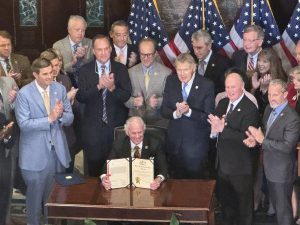 In a significant move for SC’s economy, Governor Henry McMaster ceremoniously signed the groundbreaking legislation that lowers the state’s income tax rate. Set to take effect in tax year 2026, this new law simplifies our state’s income tax structure, shifting from a three-bracket system to a more straightforward two-rate system.
Under the new framework, taxpayers will face a reduced rate of 1.99% on income up to $30,000 and 5.21% on income above that threshold, down from the previous 6.0%. This reform is projected to save taxpayers a staggering $325 million annually.
McMaster emphasized the importance of this legislation, stating, “Cutting the personal income tax has long been a top priority… and keeps more money in the pockets of hardworking South Carolinians.”
I have served on various House tax committees for 16 years. Most of the recommendations we made went nowhere. Then, a few years ago, we implemented incremental tax reductions, lowering SC’s top income tax rate from 7%, the highest in the Southeast. It’s currently at 6%, and with this tax cut, it drops to 5.21%, which is competitive with NC and GA. Even better, given SC’s robust economic growth, this tax reform package includes annual triggers that will use additional revenue to reduce the state’s income tax to less than 2%, and maybe even eliminate it.
The tax reform signed by the Governor is a fairer approach to income taxation. It lowers the rate and spreads it over a larger proportion of taxpayers. Currently, 44% of wage earners don’t pay state income taxes. Under this plan, forecasters expect 43% of filers will reduce taxes by nearly $308 million in the first year. 35% of filers will see no change, and 22%, while 22% will pay more.
Opponents of tax reform claim we are taxing the poor, but they fail to back up their wailing with these facts. For all those earning less than $50,000 a year, the average income tax increase would be about $70. The highest income bracket ($40,000-$50,000) would pay an additional $92. It is doubtful that paying that tax will be a severe hardship, but like other taxpayers, they will have “skin in the game.”
Bottom Line: This is not a tax swap as we’ve seen in other states. We are cutting taxes without shifting the burden elsewhere, focused on real relief today while building a stronger, more competitive future for South Carolina. We’re putting money back where it belongs — in the pockets of our citizens. The plan delivers over $325 million in immediate income tax relief, helping hardworking South Carolinians keep more of their earnings. Altogether, we have delivered $3.8 billion in income tax reductions since FY 2021–22.
The Heritage Act 2.0 Wins Senate Approval
If you are new to SC and care about its history, I recommend becoming familiar with the S.C. Heritage Act. Since 2000, state law has given the Legislature sole authority over whether to remove or change the name of any building or memorial on public property that commemorates American wars, as well as Native American or African American history. In 2021, the state Supreme Court upheld that authority.
In recent years, America has seen historic monuments defaced, toppled, and destroyed by mobs. SC has not been immune to this travesty of those who wish to erase history. A flashpoint was the 2020 removal of the bronze statue of John C. Calhoun from a downtown Charleston park by wrong-headed city officials. The Heritage Act is being updated to meet the new challenges.
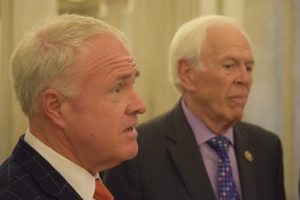 Sen. Danny Verdin and I filed companion legislation in the House and Senate this session, with the understanding that the Senate would need to move the bill first. That mission was accomplished this week. Along with 31 co-sponsors, Sen. Verdin navigated a difficult legislative path, leading the Senate to pass S.508 this week, which extends protections to all memorials on public property in SC. The vote was 31-7.
The bill adds colonial wars and any armed conflict involving South Carolinians to that list of protected categories, as well as memorials dedicated to any deceased historic figure or any historical or “commemorated” event.
It also halts the use of digital codes or informational plaques placed near some monuments in recent years that offer a broader context for the thornier parts of history. And private groups could sue to enforce the measure, allowing a judge to order restitution. It also says that if a building needs to be demolished or public property is sold to a private group, a monument or plaque can be moved to another, equally prominent public location.
The measure now heads to the House, where Speaker Murrell Smith confirmed Thursday that it will be sent to the Judiciary Committee for consideration within the next few weeks.
SC’s ‘Hands-Free’ Law is Reducing Crashes
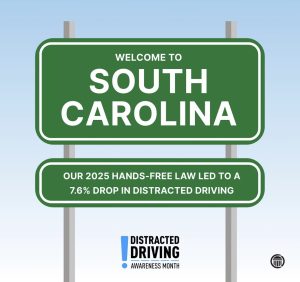
South Carolina became the 33rd state to ban the use of handheld phones while driving. Proof is in – the law is working!
Cambridge Mobile Telematics analyzed the early impact and found substantial progress.
In the first full month that SC’s Hands-Free law was in place, September 2025, phone motion distraction dropped 7.6%. In the first week, handheld call times dropped 9.7%. And that was when only warning tickets were being issued to violators.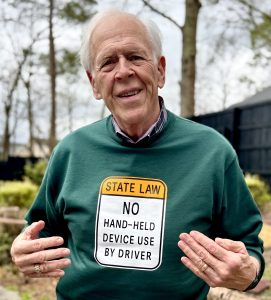
Cambridge estimates these reductions helped prevent 130 crashes and 50 injuries on the road.
South Carolina’s hands-free law shows that strong policy can drive meaningful change.
Passed by The House This Week
Protecting Children
The House passed the Student Physical Privacy Act and sent it to the Governor’s desk this week because every girl deserves to feel safe at school. This legislation (H.4756) protects privacy in restrooms and locker rooms by establishing clear, commonsense standards that families across South Carolina have been asking for. This bill puts parents back in the driver’s seat and ensures our schools remain safe, respectful environments for every student.
Supporting Families
Supporting families and protecting our most vulnerable continue to be top priorities. S.32 passed both chambers and is headed to the Governor’s desk, creating tax incentives to support pregnancy resource centers, maternity homes, and organizations that assist victims of human trafficking. This legislation strengthens the network of care available to women, children, and victims who need it most.
Compassionate Legislation
In a unanimous 105-0 vote, the House passed H.4611, ensuring that mothers of stillborn babies receive paid parental leave. This compassionate measure provides support to families during one of the most difficult moments they can face, and it reflects our commitment to standing with South Carolinians in times of both joy and hardship.
Regulating Drones in SC
The SC House has unanimously passed the “South Carolina Drone Regulation and Public Safety Act,” sending it to the Senate. This bill (H.4679) establishes guidelines for unmanned aircraft operations in compliance with FAA regulations. It defines critical terms related to drone use, including commercial and recreational operators, and outlines penalties for violations at specified sites. Penalties range from fines of up to $1,000 and 30 days in jail for misdemeanors to fines of up to $50,000 and up to 15 years in jail for felonies.
Truth in Labeling
We also made strong progress on legislation to protect South Carolinians and stand up for our local industries. The Truth in Labeling Bill (H.4248) passed the House unanimously! This is a major win for our coastal communities and local shrimpers. By requiring clear country-of-origin labeling, this bill ensures consumers know exactly what they’re buying, prevents imported seafood from being passed off as local, and gives SC shrimpers a fair shot at competing and thriving in their own market.
Racing Facility Noise Bill Advances to Senate
The House passed a bill to address noise from racing facilities. This bill (H.4706) protects certain racing venues from lawsuits by nearby landowners who bought property after the facility was established. This protection applies within a three-mile radius and requires facilities.
New Bill Targets Misrepresentation in Electronic Monitoring
The House has passed legislation to regulate electronic monitoring companies. This bill (H. 5401) empowers the SC Law Enforcement Division (SLED) to establish regulations for certified providers of electronic monitoring devices. It also penalizes anyone who misrepresents their certification to courts, bondsmen, or government agencies, with fines of up to $3,000 or up to 3 years in prison.
LOOKING AHEAD…
- The House Judiciary Committee gave a favorable report to 4641, sending it to the House floor for debate. It would add kratom with any amount of synthetic ingredients to the list of Schedule I Controlled Substances. It would also repeal the South Carolina Kratom Consumer Protection Act.
- The Judiciary Committee passed 3408 to protect SC land and critical resources from foreign adversaries. This bill restricts foreign ownership of agricultural land and property near sensitive military and infrastructure sites, helping safeguard our farmland, strengthen national security, and ensure South Carolina’s future stays in the hands of Americans, not hostile foreign actors.
- Last but not least, the Safe School Act advanced through the House Education Committee. This bill (5201) strengthens coordination between law enforcement, schools, and state agencies to create clear, unified safety plans. Every parent should feel confident that their child is safe at school, and every teacher and staff member deserves the same peace of mind.
The State of SC’s Judiciary is Good
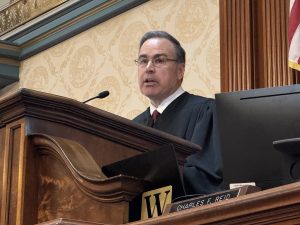 In his annual message to the General Assembly, Supreme Court Chief Justice John Kittredge called for modest reforms and defended the process by which state judges are chosen.
Kittredge said. “There is no perfect way to select judges, but I suggest to you that the legislature has elected quality judges over the years. When this legislative body of 170 diverse members individually vets judicial candidates and then collectively elects judges, that diffusion of authority enhances merit selection.”
Most other states use different methods, including popular votes or systems in which the governor has varying degrees of input into how judges are selected.
“Were one person allowed to completely control the selection process, we would expose the process to the potential of having political consideration driving the process and not merit,” Kittredge said.
Kittredge added, “I know firsthand that South Carolina has one of the finest judiciaries in the country.”
The Chief Justice also called for expanding the Judiciary to keep pace with SC’s burgeoning population. In terms of percentage growth, SC is the fastest-growing state in the nation, with a current growth rate of about 80,000 people per year. The population has skyrocketed to 5.3 million. While there are only 53 resident circuit court judges to manage both civil and criminal dockets of serious cases. Kittredge also called for reform of the Magistrate system, which is currently before the General Assembly.
Population Growth Hits Home
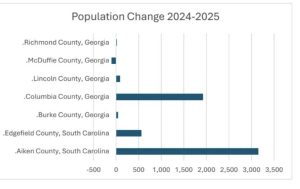
Population growth referenced by the Chief Justice is evident right here at home. The Census Bureau recently released population data for 2024-2025. In the CSRA, Aiken County in South Carolina and Columbia County in Georgia grew by more than 5,000 residents.
For Aiken County, most of the population change was due to migration (+2,752), of which only 81 persons were international migrants. Similarly, in Columbia County, net migration was 1,422, but almost a third were international migrants.
The full story can be found in the Augusta Business Daily.
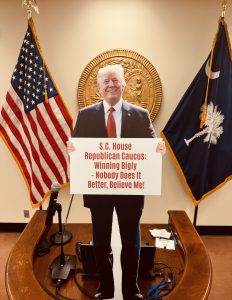
PHOTO OF THE WEEK