
Dear Friends:
While the House was in session this week, word quickly spread of a critical vote on the other side of the State House. The Senate rejected the House-passed tax conformity bill — a move that denies many taxpayers the benefit of recent federal tax relief.
I shared my immediate reaction on social media: “Breathtakingly disappointed. The House unanimously passed conformity. The Senate didn’t.”
Tax Conformity Fails
 What is typically a routine annual update, aligning state tax law with federal changes, has become anything but routine this year. On a 27–16 vote, the Senate killed the tax conformity bill on second reading.
The House-initiated legislation would have aligned SC’s tax code with federal provisions for 2025 – taxes which are currently being filed. This would allow taxpayers to benefit from the Trump income tax cuts enacted by Congress in the One Big Beautiful Bill.
It is estimated that conforming to the new federal law would result in a $289 million reduction in state revenue.
Senate leaders contend the measure could jeopardize a separate property tax relief plan and create long-term budget pressures. Senate Majority Leader Shane Massey called the proposal “terrible policy,” warning it could shift financial burdens to future generations.
Supporters of conformity, including Aiken Senator Tom Young, argued the change would provide immediate relief to taxpayers.
This issue is far from settled. Expect tax conformity to resurface as budget negotiations continue in the weeks ahead.
SC Law Enforcement to Partner with ICE
After much partisan debate, the House passed a significant public safety and immigration enforcement measure to enhance cooperation between local law enforcement and federal immigration agencies statewide, 85-30. This Republican-led legislation (H.4764) marks a substantial policy shift towards mandatory statewide participation in federal immigration enforcement efforts.
Key provisions require all law enforcement agencies operating correctional facilities, such as county jails, to enter into formal agreements with federal authorities, including ICE. Agencies must adopt programs like the 287(g) partnership, which enables trained local officers to identify and process individuals who may be unlawfully present in the country while in custody. Additionally, the South Carolina Law Enforcement Division (SLED) is tasked with developing training programs to ensure compliance with federal standards.
This legislation will enhance public safety by ensuring individuals in custody are properly screened for immigration violations and by strengthening coordination between state and federal authorities.
Insurance Reform Bill Targets Lower Rates
 The House passed a comprehensive insurance reform measure aimed at lowering premiums and protecting policyholders across the state.
At its core, the bill (H.4817) increases transparency by requiring insurers to better justify rate hikes and report on whether reforms are delivering real savings to consumers.
It also cracks down on fraudulent practices that drive up costs for everyone. It prohibits contractors from offering to waive or absorb insurance deductibles to secure business — an increasingly common tactic that inflates claims and ultimately raises rates. The legislation also strengthens enforcement tools for the state’s Insurance Fraud Division.
The bill also invests in prevention. It expands programs and incentives that help homeowners strengthen their properties against storms and other risks, reducing the likelihood of costly claims. Tax credits for fortifying your home with hardening improvements and a proposed sales tax holiday on disaster preparedness supplies are included.
Additional provisions address auto insurance, including protections for drivers filing uninsured motorist claims and options for no-deductible glass coverage.
This legislation represents a broad effort to reduce costs, improve accountability, and bring long-term stability to SC’s insurance market. However, legislation can only set the table for insurers – there is no guarantee rates will be lowered.
Accountability for Tenured College Faculty
It is long past the time to reform tenure for college professors. In the real world, no one gets a lifetime employment contract and is mostly shielded from being fired. This week, the House passed a transformative higher education reform aimed at enhancing accountability for tenured faculty at public colleges and universities.
This legislation (H.4761) shifts tenure management from a near-permanent status to a system of ongoing evaluation. Institutions will be required to conduct regular performance assessments that evaluate teaching effectiveness, research productivity, and overall contributions. Notably, the bill introduces consequences for consistently poor performance, potentially leading to tenure revocation after multiple unsatisfactory evaluations. This reform ensures quality instruction and aligns higher education with performance standards seen in other professions.
House Passes Tough on Crime Bills
 Sexual Exploitation of Minors. The House unanimously passed legislation that strengthens deterrence and reflects the seriousness of child exploitation crimes in the digital age. H.4804 increases penalties for sexual exploitation of minors, raising minimum prison sentences to five years for first-degree offenses and three years for second-degree offenses. It also restructures third-degree penalties based on the number of illegal images, with sentences of up to 10 years in prison. Repeat offenders already on the sex offender registry would face a mandatory minimum of five years.
Taking Down “Street Takeovers.” The “Roadway Protection and Safety Act” aims at cracking down on dangerous and disruptive “street takeover” events. The bill (H.4292) makes it illegal to participate in, organize, promote, or assist in a street takeover —defined as the coordinated blocking of roads or parking areas for illegal driving stunts such as burnouts, drifting, racing, and other reckless maneuvers. It goes beyond drivers. It also targets organizers and promoters who use social media, as well as those who aid or facilitate these events, reflecting how these gatherings are often coordinated online. Penalties include fines and jail time.
Protecting Law Enforcement Animals. Our 4-legged LEO’s must be better protected. On a vote of 106-2, the House passed “Fargo’s, Hyco’s, Rico’s, Coba’s, Wick’s, and Mikka’s Law” — a measure designed to increase protections for law enforcement animals, including police dogs and horses. The bill (H.3034) expands current law. It makes it illegal not only to injure or kill these animals, but also to taunt, torment, or interfere with them while they are performing their duties.
Protect Children from Addictive Social Media Practices. Children don’t fully understand the risks of social media addiction—or how to avoid it. That’s why the House passed the Stop Harm from Addictive Social Media (SHASM) Act this week, a comprehensive effort to better protect minors online. The legislation (H.4591) requires social media platforms to verify users’ ages and implement stronger safeguards for children. It targets features designed to maximize screen time — such as endless scrolling, autoplay videos, and constant notifications — unless meaningful protections are in place. Just as important, the bill strengthens parental control. This is about putting guardrails in place—so technology serves our children, not the other way around.
Hands Off the Cellphone!
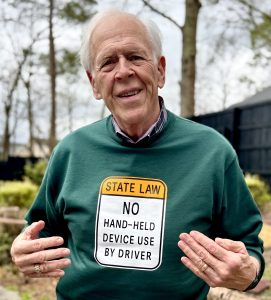 If you are still holding your cellphone while driving, this message is for you. Count yourself lucky if you didn’t get a traffic ticket during the first month of enforcement of the new HANDS-FREE law in SC. Law enforcement is serious about punishing people who use their cellphones while driving. SCDPS reports that 3,500 drivers have been cited for violating the hands-free law since it went into effect on Feb. 28. At that pace, there will be 42,000 tickets written this year.
While fueling my car yesterday, a Trooper at an adjoining gas pump proudly told me how many tickets he had written and said that during one week in March, Aiken County drivers received the most tickets of any county in SC.
Violations can be costly: $100 for the first offense, and $200 and 2-points on your driving record for the second and subsequent violations. Court fees per ticket can be $130. (Learn more about HANDS FREE)
LEGISLATIVE BRIEFS
Protecting Privacy: The House has passed the “Personal Privacy Protection Act,” which aims to safeguard the personal information of nonprofit supporters. This legislation (H.5075) prohibits state and local agencies from collecting or publicly disclosing details about nonprofit donors, members, or volunteers, including sensitive information such as names and financial contributions. Supporters argue that this protection is vital to prevent harassment and intimidation.
Court-Appointed Child Advocates: This week, we moved to strengthen accountability and child safety within the family court system. The House has passed a vital child-protection measure that enhances standards for guardians ad litem — those appointed by family courts to represent children’s best interests in custody and abuse cases. This legislation (H.3013) mandates criminal background checks for these advocates.
Expanding Child Safety: The House approved and sent to the Senate H.3873, a bill that updates existing law to require public schools to distribute child identification kits containing fingerprint and DNA collection materials to parents of elementary school students on a mandatory basis, rather than only upon request. This is a straightforward, preventive approach to child safety — providing families with practical resources to protect children and assist authorities if the unthinkable occurs. The bill does not create new reporting requirements or databases; instead, it focuses on education, preparedness, and parental involvement.
Updating DMV Accuracy of Driver Records: The House voted in agreement with Senate amendments to send H.3856 to the Governor for his approval. It is a wide-ranging update to Department of Motor Vehicles (DMV) laws aimed at improving accuracy, efficiency, and accountability. The bill removes outdated requirements — such as listing a driver’s blood type on license applications — and replaces them with more flexible “information” standards. It also sets clearer rules for adding medical details to identification cards and creates a legal remedy if inaccurate information causes harm. Overall, H.3856 modernizes DMV operations while improving the reliability of driver records and consumer protections.
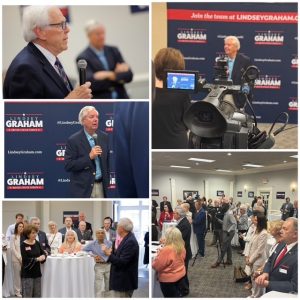 This week, it was my privilege to introduce “The Kid from Central.”
I was the setup guy at Sen. Lindsay Graham’s Meet & Greet in Aiken. I joked that everyone knew Lindsay from the daily dribble from the “Lame-Brain-National-News-Propaganda-Machine,” so I started my talk focusing on his childhood.
Growing up in Central, SC, he lived above his parents’ restaurant-bar-pool hall-liquor store. His mother died of cancer when he was 19, and his father passed a year later. As a college student, he became his younger sister’s guardian. Those years laid the foundation for Sen. Lindsay Graham’s determination to protect America and become the national leader he is today. I’m glad he’s still “The Kid from Central.”
Bills on The Move…
SCDOT Modernization
 The House Ways & Means Committee voted to send the House a comprehensive bill designed to modernize the administrative, governance, and financial frameworks of the South Carolina Department of Transportation (SCDOT). It shifts SCDOT from a commission-led governing body to an executive-appointment model while retaining the SCDOT Commission with fewer members and streamlined duties. The bill (H.5071) also broadens SCDOT’s toolbox for funding, tolling, contract options, procurement, and public/private partnerships.
The bill updates turnpike statutes to allow the development of “choice lanes,” enabling self-funded projects. To mitigate the decline in gasoline user fee revenue resulting from the transition to electric and hybrid vehicles, the bill implements a modernized fee structure for alternative-fuel vehicles. The bill also provides for the voluntary transfer of local roads to local jurisdictions and establishes local funding options for maintaining those roads.
Tax Credit for Donations to Pregnancy Resource Centers
W&M’s Committee also sent S.32, known as the Pregnancy Resource Act, to the House for debate, which takes a new approach to supporting women, children, and families by providing a state income tax credit for donations to pregnancy resource and crisis pregnancy centers. Under the bill, taxpayers who make voluntary cash contributions to eligible nonprofit organizations could receive a nonrefundable tax credit worth up to 50% of their state tax liability, with unused credits carried forward for up to five years. Instead of growing government, this bill encourages private donations to pregnancy resource centers, maternity homes, and programs that support victims of human trafficking. This is about strengthening SC families in a responsible and community-driven way.
Rural Healthcare Access
The W&M’s Committee approved a healthcare measure aimed at improving access to medical services in rural communities. The bill (H.5173) updates state law to expand the definition of “hospital” to include facilities that convert to Rural Emergency Hospitals, a newer federal designation designed to help struggling rural hospitals remain open. These facilities can provide emergency and outpatient care without maintaining full inpatient services, helping communities retain critical access to care.
Protecting SC’s Farms
We continue to advance legislation (H.3408) to protect SC’s agricultural land as part of a broader effort to strengthen our state’s security and safeguard critical resources. This bill prevents foreign adversaries from purchasing or owning farmland in SC, helping safeguard our food supply, national security, and long-term economic stability. Protecting our land is critical to protecting South Carolina’s future.
Self-Service Lottery Ticket Machines
Ways & Means also approved a bill (H.5057) that would allow lottery retailers to use self-service vending machines to sell lottery tickets, which would reduce checkout lines at convenience stores. The bill authorizes these machines to sell tickets and pay out smaller prizes, while requiring ID verification to prevent underage purchases. The change would modernize lottery sales while maintaining safeguards to ensure responsible use.
Setting Salaries for SC’s Top Jobs
Another bill approved by the W&M’s Committee would change how salaries are determined for the Governor and Lieutenant Governor. Salaries for these positions would be based on recommendations from the Agency Head Salary Commission, rather than being fixed by statute. H.5018 requires the commission to conduct a comprehensive salary study every four years, comparing responsibilities and compensation with similar offices in other states.
PHOTO OF THE WEEK